Based off the idea of DAM Awards, Createasphere is calling all Digital Asset Management Innovators for their first annual DAMMY Awards.
“If you or your organization has broken new ground in managing digital and media assets, it’s time to stand up and be recognized! Createasphere is excited to announce the first annual DAMMY Awards, recognizing innovators who have created new revenue opportunities, efficient workflows, exceptional storage and archive solutions, and more. An outstanding individual or organization will also be named DAMMY of the Year for positively impacting the success of digital asset management for the good of the global community.
But don’t wait for the August 20th entry deadline- submit your project or solution today and be acknowledged for your hard work in front of your community of peers. Winners will be recognized at a special awards ceremony luncheon at the Digital Asset Management Conference and Expo, September 24 in New York.”
The categories include:
DAMMY of the Year
Best Storage, Archive, and or Preservation Solution
Best Strategy or Solution for Digital & Media Asset Management during the Acquisition of Content
Best Example of Asset & Media Repurposing
Submit all entries and nominations between July 6, 2010 and August 20, 2010
Do you know someone who qualifies for a DAMMY? Well then what are you waiting for?
As a Digital Asset Management professional, one of the many non-tangible things I deal with on a regular basis is metadata. This is a must. Any standards which already exist can help as a starting point. There is no sense recreating the wheel from stone since someone has done that work for you by putting advanced knowledge and further development behind it.
The issue is there are many, many standards for metadata. Some are based off of each other. Some standards are quite common, while others are designed for a very specific audience. Which metadata standard(s) you end up using should relate back to your:
Assets
Business needs
People
Use cases
Something to keep in mind is what information:
you already have from the past (is this information accurate and still relevant?)
you are collecting/creating now (is this done consistently?)
you will need for the future (think beyond the current project and fiscal period)
Will these metadata standards meet all your metadata needs? For the most part, yes. It is worth taking a deep look at these metadata standards.
There are several comprehensive guides to metadata worth sharing since they are freely available:
The first guide is from NISO about Understanding Metadata which contains quite a few references on everything you wanted to know about metadata, but was afraid to ask.
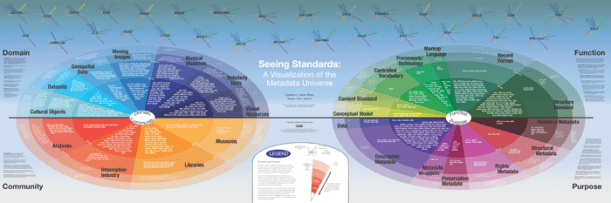
Another set of guides are more recently authored by Jenn Riley, who was funded by the Indiana University Libraries White Professional Development Award where she developed a visual representation of 105 different metadata standards along with Devin Becker. Their site mentions:
“The sheer number of metadata standards in the cultural heritage sector is overwhelming, and their inter-relationships further complicate the situation. This visual map of the metadata landscape is intended to assist planners with the selection and implementation of metadata standards.
Each of the 105 standards listed here is evaluated on its strength of application to defined categories in each of four axes: community, domain, function, and purpose. The strength of a standard in a given category is determined by a mixture of its adoption in that category, its design intent, and its overall appropriateness for use in that category.
The standards represented here are among those most heavily used or publicized in the cultural heritage community, though certainly not all standards that might be relevant are included. A small set of the metadata standards plotted on the main visualization also appear as highlights above the graphic. These represent the most commonly known or discussed standards for cultural heritage metadata.”
This is complimented with A Glossary of Metadata Standards in pamphlet form and poster form, also created by Jenn Riley and Devin Becker.
Having this visual mapping helps people like me who deal with information in this manner regularly. I like this so much, I saved these posters and guides (all PDF). I even added the visualization as a screen saver on my work computer.
In the cases when these metadata standards do not meet your metadata needs and use cases, some people mix several standards together into metadata mashups which may be more successful rather than trying to carve your own standard out of stone.
Let us know when you are ready for some vendor neutral consulting on Digital Asset Management.
I just returned from a DAM Conference and DAM Tweetup where I was able to meet with many more like-minded people in the field of Digital Asset Management (DAM).
More and more people are aspiring to get into the field of Digital Asset Management, like any other domain, but the issue is how:

 Another DAM Blog