When we drive most vehicles, these have a dashboard with gauges telling us the important things we need to know about what is happening with the vehicle and how it is going. The dashboard may indicate speed, how much fuel is left plus warnings like temperature in case things are not going as well as they should be.
When executives want to know the status of what they are in charge of to help them make informed decisions based on the data, they could have a online dashboard with that information. This dashboard may tell them what they need to know about sales figures, units produced, project milestones reached, global growth by region or whatever information is relevant to them as it changes daily, weekly, monthly, quarterly and/or annually.
Some DAM systems have dashboards too. Sometimes these dashboards are part of the DAM system and sometimes they are extra add-ons which may measure data from other related ECM systems as well.
Why have a dashboard? Would you rather be uninformed? Do like shuffling reports or spreadsheets instead? Would you rather script your way through this data because there is some illusion that this is easier to do on a daily or weekly basis, then filter to the information needed each and every time?
Does a frequently updated (or live) presentation of the information you need to make informed decisions (based on the actual data, not gut feelings) sound more useful? Why would you not want this? Are you afraid of progress or the lack of it? Do you fear having this measured for you in useable numbers and digital charts so you can find out what is not working as well?
To paraphrase Peter Drucker, we can not manage what we do not measure and we can not measure what we do not define. If we do define what we need to measure, we can add this to dashboard, analyze the data in a clear, manageable way and make informed decisions as we watch the changes over time.
In May 2011, I gave a presentation about DAM Reporting, Measuring and Auditing at the Henry Stewart DAM Conference in New York City. I spoke about how to measure what is happening within the DAM and the power of DAM reporting. Some might think it is a really boring topic. So did I, but it was worth talking about since no one else was. It was so boring that the room for this presentation was standing room only. Not so boring I guess.
How to measure what is happening within the DAM comes down to filtering and using a dashboard. You could do that with reports with more processing and analysis. It is just more work.
Everyday, we are have more data, information and knowledge rain down on us. Managing this mountain of data is a matter of filtering to what is needed. If we are drowning in it, Clay Shirky put it best by explaining this is simply filter failure.
Being uninformed and ignorant of what is going on with your technology as well as your business is so 20th century. Filter. Analyze. Prioritize. Get a dashboard and use it to look at what the data and information says about what you define, measure and manage.
There are 168 hours in a week. Many of us work about 40 hours each week. Some of us may work more, less or not at all. I have worked plenty of 22 hour work days and 100 hour work weeks. But this is not a race on how fast we can burnout.
After working with Digital Asset Management for a number of years, there is constantly more to do. The work and data multiples over time and the way it happens is much less fun than how rabbits multiply.
Schedules fill up and then get double booked. And there is plenty of fighting fires as well. Eating gets postponed past dinner. Sleeping is postponed again. Breathing got canceled too.
Scaling and automation is explored in any way that will increase accuracy, efficiency and effectiveness. Otherwise, mentions of cloning ones self continue to arise.
Weekends evaporate into part of the work week. Then holidays become more time to focus on work. Then vacation time vanishes. Another high priority project get scheduled over a planned vacation. Again. Last time I did take some vacation days (vacation hours), I was emailed and called in a panic to fix something critically important. Did I forget to mention I how much I love not having backup (person) to resolve these kind of matters? How dare I sleep at 3:00 AM or become sick or go on vacation.My no-life membership card might get revoked.
Projects come and go. Or simply accumulate because of some other new priority. Or resolve some [fire] of the day. Not to worry, the world still spins whether we are working or not. Deadlines may fall behind if a user [forgot] something important. These projects have a closing date, right?
Dealing with time
There are 168 hours in a week. What do you do with those hours?
Document what you do with your time and find out. Regardless of whether you:
are hourly or salaried
have a time sheet to fill in or not
Note every task you work on during each block of time.
How long did you spend on each of these tasks? Build metrics. Note patterns. Adjust accordingly.
I happen to add this information to my online calendar(s) everyday (before or after the occurrence) so it is recorded in one place for the purposes of weekly reports, improving my time management (eliminating wastes of time and pin pointing what really takes up my time every week).
This also documents the time spent for others to see later on, to help prove whether you need help to scale the efforts of digital asset management within your organization beyond the one person who is often solely dedicated to this. Imagine this. One person, workload tripling each year. How do you prove you need assistance to the business people in your organization?
Ask for assistance (do not whine)
Prove you need assistance with your documented work hours on xyz tasks completed over a given period of time (such as a few quarters or a year).
Prove the workload is increasing with measurable numbers.
Repeat
All of these tasks may be necessary, but it will help identify and document what takes up your time so you can realize “Oh, it is Tuesday and I have already worked 40 hours this week. Again. This is normal, is it not?”
Find out what tasks really eat up most of your time.
In a perfect world, I divide all my waking hours with an uneven balance between:
Work time
Family time
Friend time
Me time (alone)
Moderation is one of the keys. Excess of anything is not a good idea.
While you may be the internal representative and/or go-to person for the DAM system, you are not the DAM system. Do not take it personally when the DAM does not work “perfectly.” If there is criticism or suggestions to improve the DAM, get this in writing (email usually works) from the person making the comment. Then, prioritize it among all other tasks and address it accordingly. There may be very valid points made, so keep your ears open and listen.
The reality is each of us is just one person, but we are not alone. You should refer to others when they may know more about a particular topic. I refer to others often because I do not pretend to know better about everything.
Getting the work done
I love to get the work done right the first time. I thrive on it. The key is getting it done right. Right is done the best you can. It needs to be right, not perfect. Nothing is perfect because everything can be improved over time.
Stress
Anyone in today’s working world has stress. Or they simply do not do anything.
Many wondered how I work so much at my regular job and still find time to write this blog over the past few years. Lack of sleep is one answer. Not a good idea though. Time management of my 168 hour week to the extreme? Scheduling sleep cycles as necessary. Not a good idea either. You might note I post to my blog much less often. That is because I sleep more now. I also found recording and editing podcasts faster than writing my long form blog posts. Sleeping 6 to 10 hours is a really good idea. Don’t worry, the work will still be there when you awaken. The earth does not stop rotating for anyone.
If your work is negatively affecting your health (mentally and/or physically) that should be a clear sign you need to address the issue and take action to resolve it. I am not a doctor nor do I claim to be one. It is your life. Literally.
What do you consume
How did I get a dozen empty coffee cups on my desk today? Oh wait, they are all mine. From today.
Stay hydrated (just add water)
Eat right (something dispensed from a vending machine does not equal breakfast, lunch and dinner)
When is it time to move on
Do not give up. Everyone has a different threshold. Some people can take more than others. We are all tested in one way or another.
For every position I have had since my very first job, I look at the following:
Can I make a difference?
Am I listened to?
Am I treated well?
Is this what I want to do?
Am I paid well?
I believe if none (or only one) of five questions has been answered with a yes, it is time to move on.
Listen to your family and friends
If you have an issue like being a workaholic (know any?), they will likely tell you at some point. If during social interaction (yes, with real live people. Not just virtually) the only stories you remember are work related, they may take notice. But do you notice? Some people are more vocal than others. The vocal ones care to tell you what no one else is telling you. Listen. There may be some logic in there somewhere. This is one of the reasons to make time for them. They may even want to spend time with you. Imagine that.
Are you always connected?
Do you really need to be? You may need a digital diet. Take the free quiz to find out if you need one.
If you’d like to connect, let us know when you are ready for some vendor neutral consulting on Digital Asset Management.
As a Digital Asset Management professional, one of the many non-tangible things I deal with on a regular basis is metadata. This is a must. Any standards which already exist can help as a starting point. There is no sense recreating the wheel from stone since someone has done that work for you by putting advanced knowledge and further development behind it.
The issue is there are many, many standards for metadata. Some are based off of each other. Some standards are quite common, while others are designed for a very specific audience. Which metadata standard(s) you end up using should relate back to your:
Assets
Business needs
People
Use cases
Something to keep in mind is what information:
you already have from the past (is this information accurate and still relevant?)
you are collecting/creating now (is this done consistently?)
you will need for the future (think beyond the current project and fiscal period)
Will these metadata standards meet all your metadata needs? For the most part, yes. It is worth taking a deep look at these metadata standards.
There are several comprehensive guides to metadata worth sharing since they are freely available:
The first guide is from NISO about Understanding Metadata which contains quite a few references on everything you wanted to know about metadata, but was afraid to ask.
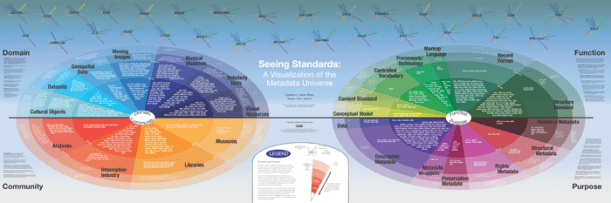
Another set of guides are more recently authored by Jenn Riley, who was funded by the Indiana University Libraries White Professional Development Award where she developed a visual representation of 105 different metadata standards along with Devin Becker. Their site mentions:
“The sheer number of metadata standards in the cultural heritage sector is overwhelming, and their inter-relationships further complicate the situation. This visual map of the metadata landscape is intended to assist planners with the selection and implementation of metadata standards.
Each of the 105 standards listed here is evaluated on its strength of application to defined categories in each of four axes: community, domain, function, and purpose. The strength of a standard in a given category is determined by a mixture of its adoption in that category, its design intent, and its overall appropriateness for use in that category.
The standards represented here are among those most heavily used or publicized in the cultural heritage community, though certainly not all standards that might be relevant are included. A small set of the metadata standards plotted on the main visualization also appear as highlights above the graphic. These represent the most commonly known or discussed standards for cultural heritage metadata.”
This is complimented with A Glossary of Metadata Standards in pamphlet form and poster form, also created by Jenn Riley and Devin Becker.
Having this visual mapping helps people like me who deal with information in this manner regularly. I like this so much, I saved these posters and guides (all PDF). I even added the visualization as a screen saver on my work computer.
In the cases when these metadata standards do not meet your metadata needs and use cases, some people mix several standards together into metadata mashups which may be more successful rather than trying to carve your own standard out of stone.
Let us know when you are ready for some vendor neutral consulting on Digital Asset Management.
I just returned from a DAM Conference and DAM Tweetup where I was able to meet with many more like-minded people in the field of Digital Asset Management (DAM).
More and more people are aspiring to get into the field of Digital Asset Management, like any other domain, but the issue is how:

 Another DAM Blog